
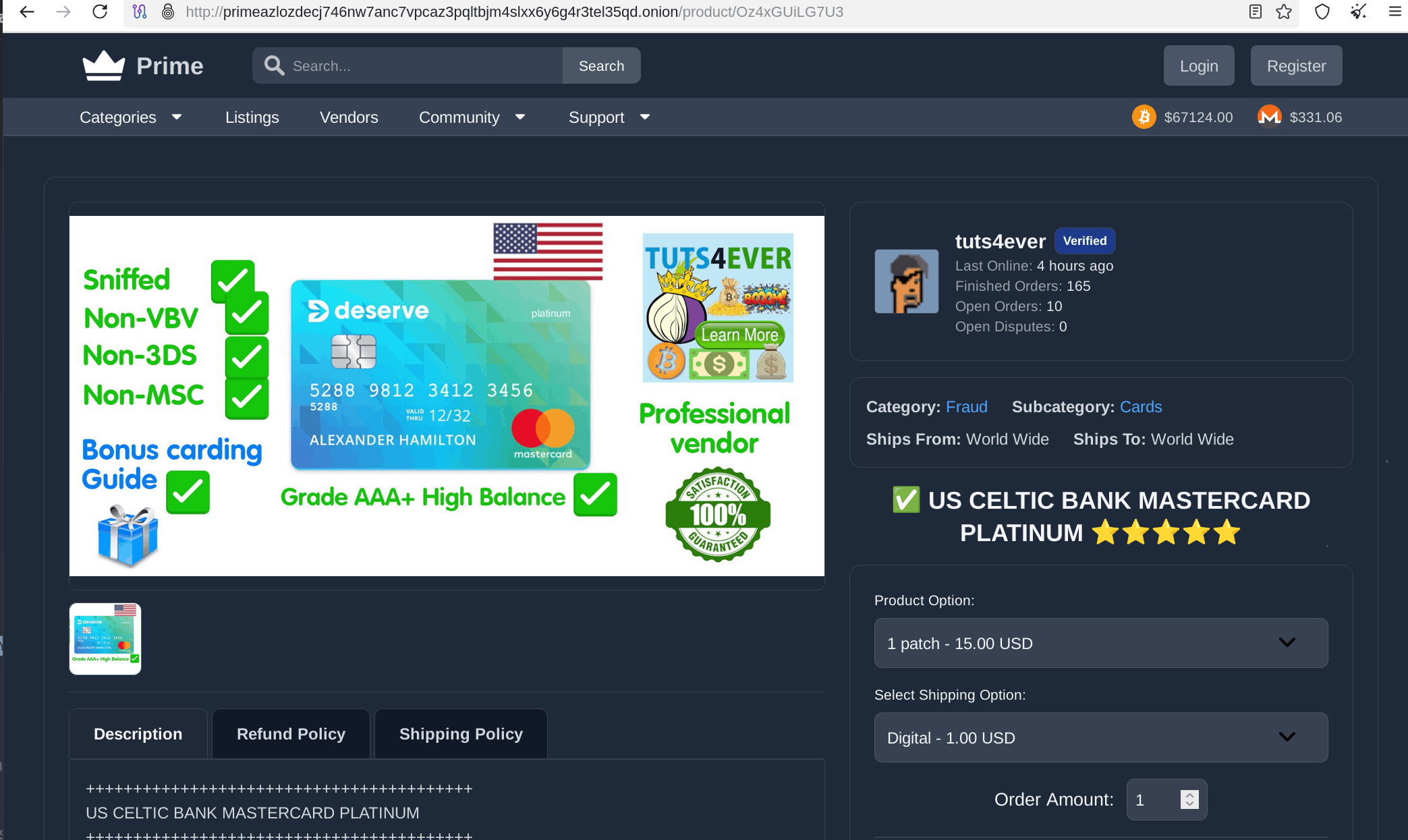
- Inside Prime Market: What a Darknet Marketplace Reveals About Crypto’s Persistent Shadow Economy
Onion: http://primeazlozdecj746nw7anc7vpcaz3pqltbjm4slxx6y6g4r3tel35qd.onion/
Clearnet: https://primemarket.link
Darknet marketplaces have been a fixture of the cryptocurrency landscape since the early days of Bitcoin, and they remain one of the most uncomfortable topics for an industry trying to establish mainstream credibility. Prime Market, a relatively recent entrant accessible via both the Tor network and a clearnet mirror, offers a window into how these platforms have evolved — and why they continue to matter for anyone trying to understand cryptocurrency’s real-world use cases, both legitimate and otherwise.
What Is Prime Market?
For those unfamiliar with how darknet marketplaces operate, it helps to think of them as e-commerce platforms — structurally similar to what you’d find in legal online retail, but built to facilitate the sale of illicit goods and services. Prime Market fits squarely within this model. It runs on Tor, the anonymizing network originally developed by the U.S. Naval Research Laboratory, and also maintains a clearnet URL — a somewhat unusual choice, since clearnet mirrors are easier for law enforcement to seize or monitor.
The platform accepts two cryptocurrencies: Bitcoin and Monero. Bitcoin, the oldest and most widely held cryptocurrency, offers pseudonymous transactions that are recorded on a public ledger — meaning they can, with effort, be traced. Monero, by contrast, is designed from the ground up for privacy, using ring signatures and stealth addresses to obscure the sender, recipient, and amount of each transaction. The decision to support both reflects a pragmatic calculation: Bitcoin brings the largest user base, while Monero appeals to those who prioritize financial privacy — or, in this context, operational security.
Registration and Security
Getting started on Prime Market is straightforward. The platform requires a username, a password, and a CAPTCHA — a process no more burdensome than signing up for most mainstream websites. Where it diverges is in the additional security layers: new users receive an Account Secret and a Mnemonic Key, which is a recovery phrase — a series of words that can be used to regain access to an account if credentials are lost. PGP encryption is mandatory for vendors and recommended for buyers, adding an extra layer of identity protection for those who choose to use it.
This security architecture is worth noting because it mirrors the tools used across the broader cryptocurrency ecosystem. Mnemonic phrases, for instance, are the same mechanism that secures billions of dollars in legitimate crypto wallets worldwide. The underlying technology is agnostic about how it’s used, which is part of what makes the policy conversation around cryptocurrency so complex.
How Payments Work
Prime Market’s wallet system functions much like what you’d find on a centralized cryptocurrency exchange, adapted for this particular context. To deposit funds, users generate a unique address — valid for six hours — and send Bitcoin or Monero to it. Bitcoin deposits require one network confirmation before being credited, while Monero requires two, with funds typically appearing within 20 minutes after confirmation.
Withdrawals carry no marketplace fee — only the underlying network transaction fee, with Monero withdrawals carrying a flat 0.0001 XMR charge. There is a rate limit of one withdrawal per hour per coin, a measure that likely serves both as an anti-abuse mechanism and as a safeguard for the platform’s own liquidity management. The minimum withdrawal thresholds are set at 0.0005 BTC and 0.002 XMR.
The platform also offers a user-to-user transfer feature — instant, with a 0.25% fee. In a legitimate context, this might resemble something like Venmo or a peer-to-peer payment system. Here, it raises questions about secondary transactions happening outside the marketplace’s standard purchase flow.
The Vendor Ecosystem
Perhaps the most revealing aspect of Prime Market’s structure is its vendor onboarding system, which operates on a tiered model. A new vendor pays a non-refundable $250 bond to begin selling. Established vendors — those who can demonstrate a track record on other platforms — can apply for free, subject to what the market describes as “good reputation verification.”
The tiers become especially significant around a feature called Finalize Early, or FE. Under standard escrow — where the marketplace holds funds until the buyer confirms receipt — both parties have a degree of protection. FE removes that safeguard: vendors receive payment as soon as they mark an order as shipped. For new vendors seeking this privilege, the bond is $5,000, non-refundable. Vendors with over 1,000 verified sales across multiple marketplaces can apply for FE status without a fee.
This tiered bond system is an attempt to solve a trust problem that has plagued darknet markets since their inception. Without legal recourse, buyers need some assurance that vendors will deliver. The bond functions as a financial commitment — a vendor who has put up $5,000 has a tangible incentive to maintain good standing. Whether that incentive is sufficient, particularly for high-volume sellers who can recoup the bond quickly, is an open question.
Vendors also receive operational tools: a Jabber-based automation bot called PrimeBot (available to higher-tier sellers), a Vacation Mode for temporarily pausing listings, and a Bulk Listings option for those dealing in volume. These features reflect a level of operational sophistication that has become standard across modern darknet platforms.
Listings and the Fent-Free Designation
Prime Market supports two listing formats — Simple and Advanced (Bulk) — with several notable features. Listings can be flagged for Finalize Early or Auto-Finalize, the latter being a timer that automatically releases funds to the vendor after a set period, even if the buyer hasn’t confirmed receipt.
One feature that stands out is the “Fent-Free” designation. Vendors can mark their listings as fentanyl-free, a claim that requires photographic evidence. This is significant because fentanyl contamination has become one of the most serious public health crises related to illicit drug markets. The presence of this feature suggests that the platform’s administrators recognize the issue — and that buyer demand for uncontaminated products is strong enough to warrant a built-in verification system. It also underscores a broader reality: that for all the technological sophistication of these platforms, the human cost of what’s being sold is very real.
The marketplace offers a range of search filters — by category, vendor, shipping origin and destination, and various listing attributes. Buyers can also hide FE-only listings or vendors in vacation mode. Functionally, the browsing and filtering experience is comparable to any mainstream marketplace.
Dispute Resolution
When transactions go wrong, Prime Market provides a dispute resolution mechanism built around a three-way chat between the buyer, the vendor, and a marketplace moderator. Disputes can be filed for non-delivery, receipt of the wrong item, partial orders, or fentanyl contamination — notably, the platform treats fentanyl presence as a standalone dispute category.
Possible outcomes include a refund, unfreezing of the transaction, or an extension of the auto-finalize timer to allow more time for resolution. It’s a system that approximates buyer protection in traditional e-commerce, with one critical difference: the moderator is employed by an anonymous, unregulated entity. There is no external oversight, no appeals process beyond what the platform provides, and no guarantee that the marketplace itself won’t disappear — taking all deposited funds with it.
This is the fundamental tension at the heart of all darknet marketplace design. Every trust mechanism — escrow, bonds, dispute resolution — ultimately depends on the continued operation and good faith of a platform that exists entirely outside legal frameworks. The history of darknet markets is littered with exit scams, law enforcement seizures, and sudden closures that left both buyers and vendors with no recourse.
The Broader Context
Prime Market does not exist in isolation. It is one of many such platforms operating at any given time, each iterating on the model established by Silk Road more than a decade ago. What has changed is the level of professionalism. The tiered vendor system, the Jabber bot integrations, the fent-free certifications, the structured dispute resolution — these are the features of a mature, iterated product category.
For the cryptocurrency industry, platforms like Prime Market remain an uncomfortable data point. The same privacy features and censorship-resistant transactions that advocates celebrate as tools for financial freedom also serve as the backbone of illegal commerce. Bitcoin and Monero don’t distinguish between a donation to a dissident and a darknet drug purchase — and that neutrality is, depending on your perspective, either the technology’s greatest strength or its most significant liability.
Regulators have increasingly focused on the intersection of cryptocurrency and illicit markets, with agencies like FinCEN, Europol, and the DOJ investing in blockchain analysis tools and enforcement operations. But as long as platforms like Prime Market can launch with relative ease, attract vendors and buyers, and process transactions through privacy-preserving cryptocurrencies, the cat-and-mouse dynamic between these marketplaces and the authorities seems likely to continue.
What Prime Market ultimately illustrates is not a failure of technology or regulation alone, but the persistent demand that drives these markets into existence in the first place — and the increasingly sophisticated infrastructure that cryptocurrency makes possible to serve it.